
Dhara
AI-Enhanced, community driven Water Resilience System
group-315
Team Members

21BAI10038 - Suraj Patil
21BCY10056 - Ayush Dhiman
21BCE11304 - Aditya Kumar
21MIP10002 - Riddhi Rai
21BCE10587 - Pranjal Nema
21BCE11028 - Harsh Raj
21BCE10042 - Lakshya BhaTi
21BCE11235 - Archit Garg
21BCE11466 - Adarsh Kumar Gupta
Contents
01.
02.
03.
04.
05.
06.
07.
INTRODUCTION
OBJECTIVE
PROBLEM IDENTIFICATION
SYSTEM DESIGN/ ARCHITECTURE
TECHNOLOGY STACK
FLOWCHART
CONCLUSION

Introduction
In an era where communities face escalating challenges related to water scarcity, pollution, and infrastructure vulnerabilities, the need for a dynamic and proactive approach to water resilience is paramount. Recognizing the urgency of addressing these issues, we present an innovative solution — the AI-Enhanced Community-Driven Water Resilience System. This comprehensive initiative harnesses the power of Artificial Intelligence and Machine Learning (AI/ML) to empower individuals within a community to actively participate in the identification, reporting, and resolution of water-related concerns.
Objective
Develop a cross-platform mobile app and website that leverages Artificial
Intelligence and Machine Learning (AI/ML) to empower users in reporting and addressing
water-related issues within a community. The system aims to provide real-time situational
awareness, aid crisis management, and assist administrators with AI-driven insights to
address and plan for water-related problems.
Implementing an AI-enhanced community-driven water resilience system faces hurdles like unequal technology access, data privacy concerns, and limited community engagement. Challenges also include sustaining the system long-term, ensuring accurate predictive models, adapting to diverse cultures and changing environments, overcoming infrastructure limitations, and promoting equitable resource distribution. Legal compliance and the need for education and training further complicate implementation. Addressing these issues is crucial to creating a successful and inclusive AI-driven water resilience system that fosters community trust, participation, and sustainable water management.
Problem identification
Technology Stack
• Frontend:
Cross-platform app (Flutter)
• Backend:
Server (Node.js),
Database (PostgreSQL)
• AI/ML:
Python (Transformers, LangChain),
Open Source LLM’s,
Computer Vision LLM’s
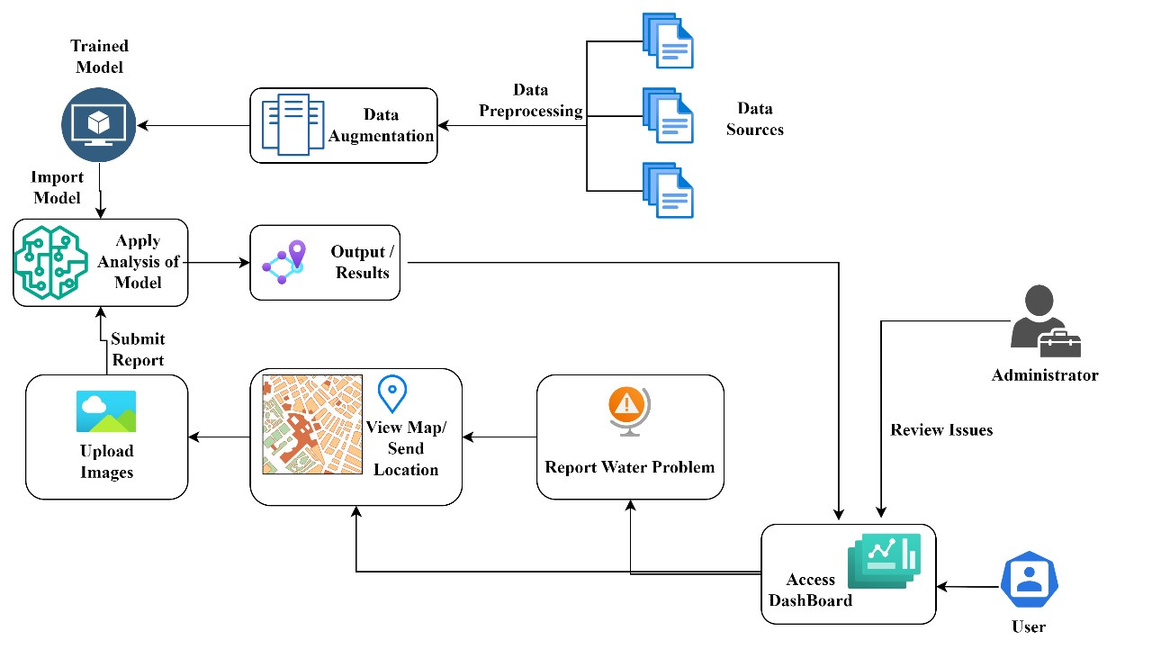
Flowchart
Conclusion
The completion of Phase II marks a significant milestone in the development of the AI-Enhanced Community-Driven Water Resilience System.
- This phase focused on establishing the project closure and documentation processes for the dashboard implementation app development and AI model generation and integration.
The successful completion of these crucial aspects lays the groundwork for the subsequent phases, which will involve the implementation, testing, and refinement of the system.
Individual contributions
- UI and App Dev. - Pranjal, Lakshya
- Authentication and CRUD - Harsh, Lakshya
- Server side request handling - Adarsh
- Maps & categorization & ML- Ayush, Archit
- Report and PPT - Suraj, Riddhi
- Survey - Aditya

System Design/Architecture
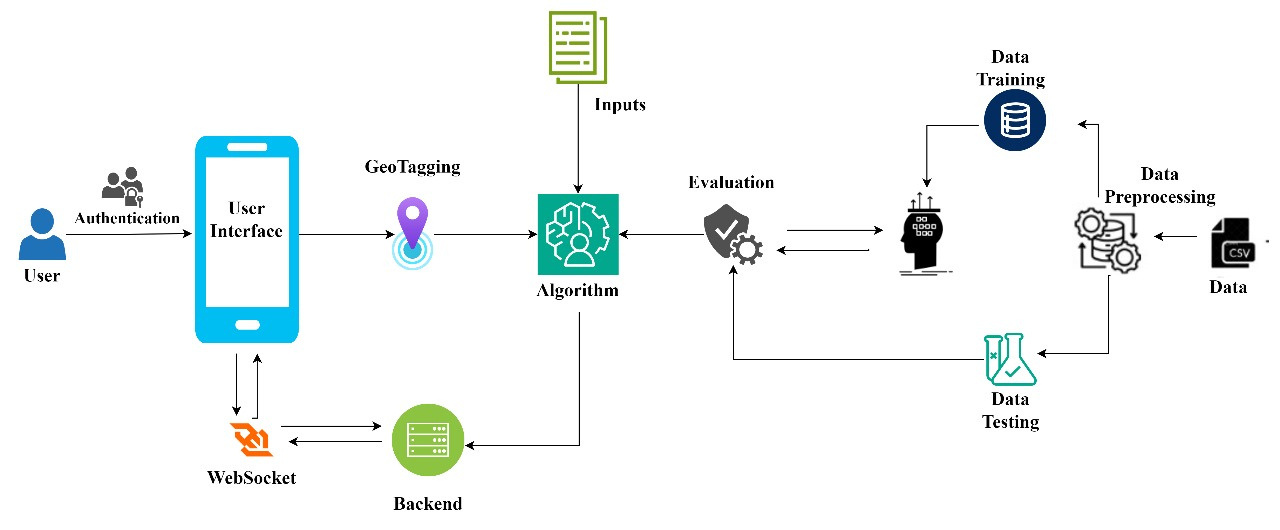
Current research emphasizes the pivotal role of community engagement, mobile technology, and Artificial Intelligence (AI) in water management. Studies highlight the positive impact of involving communities in reporting and managing water issues. Mobile applications have proven effective in facilitating citizen reporting, ensuring rapid data influx. AI integration offers real-time monitoring, anomaly detection, and crisis prediction, enhancing decision-making capabilities. Addressing challenges and ethical considerations in AI-based community initiatives is crucial. The AI-Enhanced Community-Driven Water Resilience System aligns with these findings, aiming to synergize community participation with advanced technology for sustainable water management. Real-time monitoring, coupled with AI, facilitates swift crisis response. The synergy of community and technology is crucial, as seen in the AI-Enhanced Community-Driven Water Resilience System, aligning with current research. Addressing challenges and ethical considerations in water resilience initiatives is highlighted, emphasizing the need for responsible and equitable technology use.
Literature Review